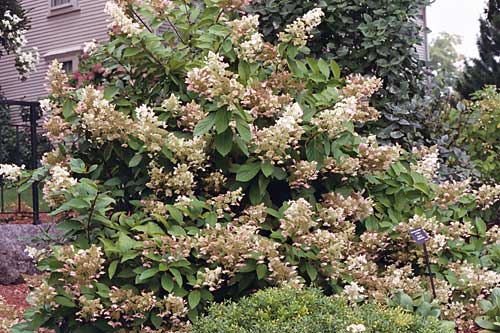
Panicle Hydrangea
Hydrangea paniculata and cultivars
The species, Hydrangea paniculata, is native to China and Japan and
was introduced into cultivation in the US in 1861 by von Siebold. In
cultivation in New England it typically reaches 8-10’ tall, and requires a few
hours of direct sunlight to flower best. Its shade tolerance, long bloom
period (July-September) and hardiness (to zone 3) add to
its appeal. The clusters of flowers are like overblown cones –6-8” long.
The many-branched
clusters bear small fertile flowers, and the larger showy sterile blossoms
are subtended by
showy petal-like sepals. White sterile flowers fade to pink, and ultimately
brown, as they age
and are held on plants often through the winter. The flowers are borne
on new wood so winter
damage of buds is not an issue as it is with the mophead, lacecap, and
oakleaf hydrangeas,
and plants will bloom even after a hard winter pruning.
|
|
H. paniculata ‘Grandiflora’, (Often
called “PeeGee”)
the most common cultivar, is an oldfashioned favorite. The large
panicles of flowers can be 12- 18” long—especially if pruned to encourage strong
flower development. Both multi-stemmed
shrubs and those trained into standards are frequently seen in
the landscapes of the northeast.
The flower panicles on ‘Kyushu’ are
not as dense as they are on “PeeGee” giving this
cultivar a more delicate air, ‘Praecox’ opens
its flowers in July, earlier than other cultivars, widening
the blooming window. ‘Tardiva’ closes
the window, beginning its bloom in August at the tail
end of the season. ‘White Moth’ bears
flower clusters that are less conical than others–flattened,
almost round clusters. These cultivars are readily available,
and can be grown with ease
knowing that they are hardy, pest and disease resistant, available
and will add a long season of
beauty to any garden.
|